

- HOME
- PSYCH SERVICES
- BUSINESS & PERFORMANCE PSYCHOLOGY
- CLINICAL, COUPLES, & FAMILIES
- Psychologist, Therapist, or Counselor? Which is Right for You
- ADHD Treatment & Evaluation Services
- Anger Management
- Anxiety Treatment & Evaluation Services
- Borderline Personality Treatment Services
- Cognitive Behavioral Therapy (CBT) Self-Help
- Couples Counseling and Marital Therapy
- Consent for Psychological Services for Minors Post-Divorce
- Depression Treatment Services
- Infidelity Recovery
- Jacksonville Counseling and Psychology
- Military Psychology & Tricare
- Narcissistic Personality Treatment Services
- Online Counseling
- Psychoeducational Testing
- Psychological Testing and Assessment
- Psychotherapy & Counseling
- FORENSIC PSYCHOLOGY & EXPERT TESTIMONY
- LIFE COACHING & EXECUTIVE COACHING
- PSYCHOLOGICAL PUBLIC DISABILITY QUESTIONNAIRES (DBQ)
- ONLINE COURSES
- Stay Crazy about Each Other
- Our Partnership Begins When You Purchase an Online Course
- Get to Know Dr. D’Arienzo, Relationship Expert
- Florida Premarital Preparation Online Course
- Georgia Premarital Education Online Course
- TwogetherinTexas Premarital Online Course
- Tennessee Premarital Preparation Online Course
- Minnesota Premarital Education Course Online
- Oklahoma Premarital Counseling Online Course
- South Carolina Premarital Preparation Course
- West Virginia Premarital Education Course
- Online Marriage and Relationship Tune Up Course
- Florida DCF Certified Parent Education and Family Stabilization Online Course
- Georgia Qualified Parent Education and Family Stabilization Online Course
- Texas Qualified Parent Education and Family Stabilization Online Course
- High Conflict Co-Parenting Online Certificate Course (8 Hours)
- Online Anger Management Four Hour Course (Level 1)
- Online Anger Management Eight Hour Course (Level 2)
- Sexual Harassment Online Training
- MMPI/GUARD/LEO
- CPI Police and Public Safety Assessment
- Florida G License Psychological Testing
- Online Psychological Testing for Armed Security Guards and Personal Protection Officers
- MMPI Texas Level III CSO and IV PPO Psychological (ONLINE)
- Requirement for Texas Security License Applicants: MMPI Evaluation
- Level 3 Security Guard New Mexico Online MMPI Psychological Evaluation
- PsychFit Systems Capability Statement for LEO and Armed Guard Evaluations
- Security Industry Partners & Training Resources
- TEAM
- BOOKS/MEDIA
Beyond Compliance: Improving Security Officer Selection Worldwide
Posted by: Dr. Justin D'Arienzo, Psy.D., ABPP
D’Arienzo Psychology · ASSIST 2026
Beyond Compliance: Improving Security Officer Selection Worldwide
Insights from Dr. Justin D’Arienzo’s ASSIST 2026 presentation, drawing on experience involving more than 6,000 armed-security psychological evaluations.
By Dr. Justin D’Arienzo, Psy.D., MSCP, ABPP
Last updated: November 17, 2026
Board-Certified Clinical Psychologist · Former U.S. Navy Psychologist
Licensed Texas Psychologist · Multistate Licensure · PSYPACT Authority
Security companies trust their officers to carry firearms, protect clients, and make decisions under pressure. A completed licensing form answers only part of the hiring question.
Employers also need to know whether the person has the judgment, self-control, reliability, and people skills the assignment requires.
That was the focus of my presentation at the 2026 conference of the Associated Security Services and Investigators of the State of Texas (ASSIST):
“Beyond Compliance: Using the MMPI to Improve Armed Security Officer Selection.”
Although I spoke to a Texas audience, the same question matters to security companies worldwide:
How can organizations turn psychological screening into a meaningful part of personnel selection?
My experience involving more than 6,000 armed-security psychological evaluations shaped the talk. I explained how testing, individual interviews, job demands, and clear employer procedures work together.
Presentation details: View Dr. Justin D’Arienzo’s ASSIST 2026 session on Whova — October 7, 2026, at The Menger Hotel in San Antonio, Texas. Whova may require sign-in.
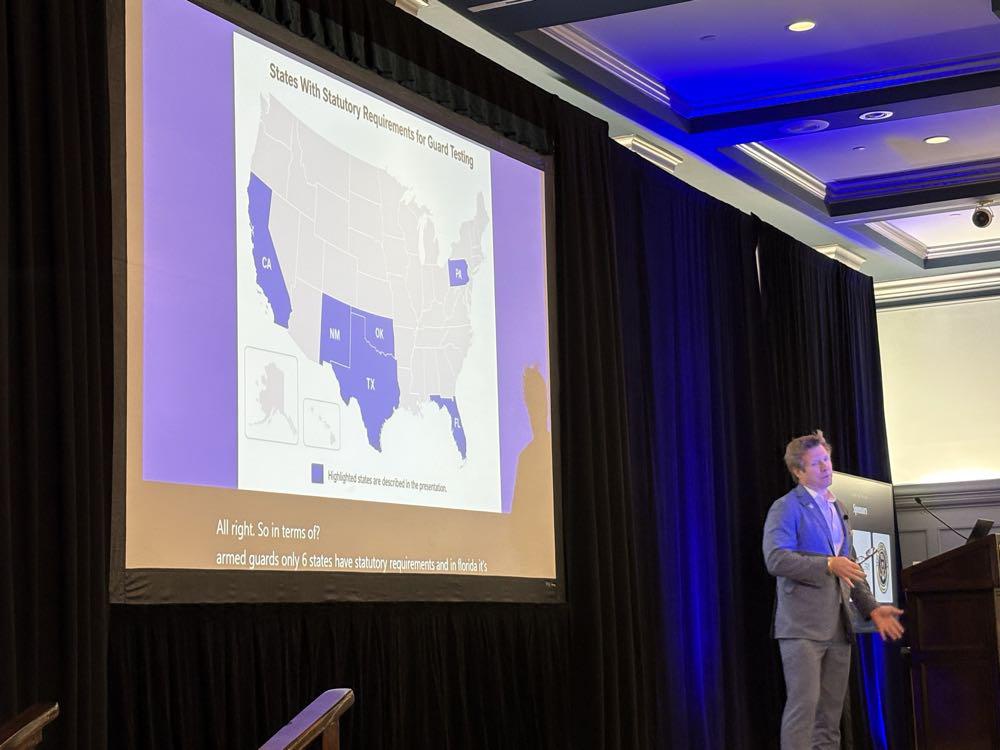
What Texas Can Teach Us About Security Officer Selection
In Texas, MMPI testing is part of licensing for commissioned security officers and personal protection officers. That makes the state a useful example of how screening and employer responsibility overlap.
However, meeting a licensing requirement does not tell an employer whether a candidate fits a particular assignment.
This distinction also matters when a company works in several states or countries. For example, hospital security and executive protection involve different demands. Employers need a process that addresses those demands as well as local licensing rules.
Start with the licensing rules. Then ask: What does this job require, and what do we need the evaluation to tell us?
My earlier article,
Armed Security Officer Psychological Screening: 10 Questions Employers Should Ask
explains the traits that matter for armed-security work. In the ASSIST presentation, I focused on how employers can use those ideas.
Putting MMPI Results in Context
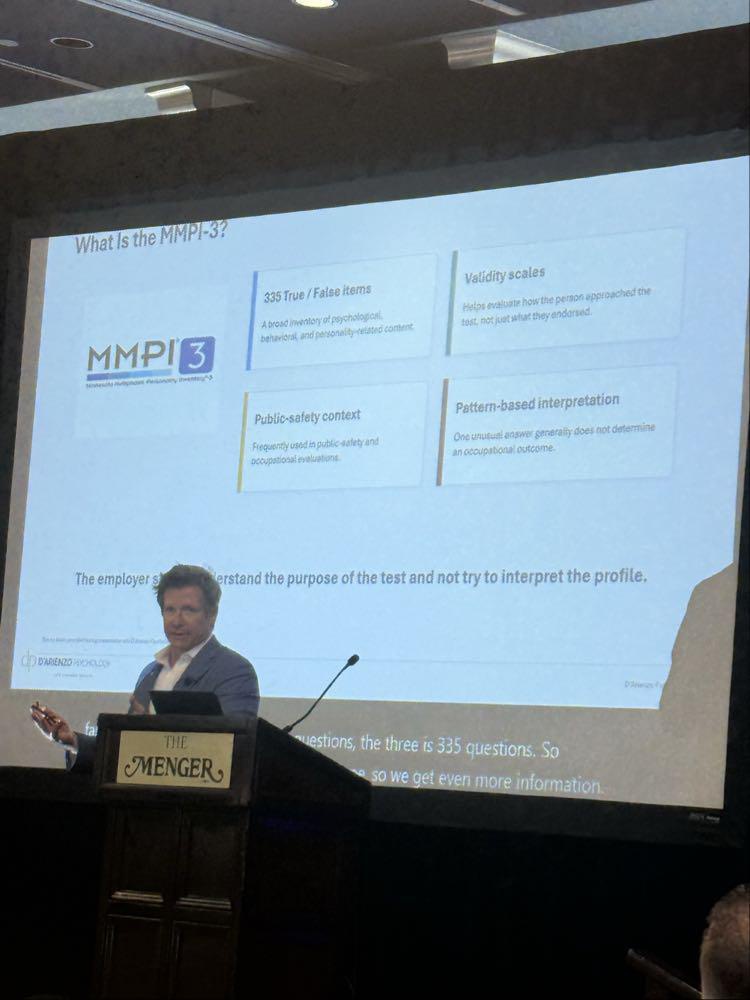
The Minnesota Multiphasic Personality Inventory, including the MMPI-3, helps assess psychological functioning. It also provides clues about how a person approached the test.
To make that information useful, a qualified evaluator must consider it alongside the rest of the assessment.
During the presentation, I emphasized a central principle:
“The MMPI is a data source. Evaluation is the integration.”
In practice, I bring several sources together: testing, a separate history and risk questionnaire, an individual interview, and information about the job. When findings need clarification, follow-up is part of that process.
For example, a candidate may have no major clinical elevations on testing. Yet the interview may reveal repeated workplace conflicts and trouble staying calm when challenged. The evaluator needs to explore those concerns and consider how they relate to the job.
A reassuring test profile should not lead an evaluator to overlook other evidence. At the same time, a concern deserves a fair review; it does not automatically mean the person is unsuitable.
Stability and Suitability: Two Different Questions
Psychological stability
concerns psychological difficulties that could interfere with safe and effective performance.
Psychological suitability
concerns whether the individual’s characteristics support the demands of the particular position.
These questions overlap, but they are not interchangeable.
For example, a person may show no major psychological problems but still raise concerns about self-control, teamwork, or judgment. Conversely, past mental-health treatment does not tell us how someone functions today. Each person needs an individual assessment tied to the job.
For security leaders, this means defining what successful performance actually requires.
| Security assignment | Demands to address in the evaluation |
|---|---|
| Hospital security | De-escalation, emotional regulation, communication with distressed people |
| Executive protection | Discretion, adaptability, situational awareness, judgment under pressure |
| Critical infrastructure | Dependability, vigilance, procedural consistency, attention to safety |
| Retail and public-facing security | Restraint, professional assertiveness, conflict management, communication |
These examples help frame the referral. They are not stand-alone hiring criteria or substitutes for a job analysis.
Applying Public-Safety Principles to Private Security
The California Commission on Peace Officer Standards and Training provides an established framework for psychological screening in law enforcement. Its
Peace Officer Psychological Screening Manual
addresses the evaluation process and job-related psychological suitability.
During the talk, I explained how private security employers can adapt relevant parts of this approach.
The work begins with the actual security assignment. Private security personnel and sworn police officers can have different responsibilities, authority, training, and operating environments. Those differences matter when choosing assessment methods and interpreting findings.
For instance, the evaluation can address how someone follows procedures, communicates, accepts supervision, and makes decisions. These are behaviors that matter on the job.
What Our Preliminary Security Officer Data Suggest
The presentation also included an exploratory comparison involving
4,619 armed-security applicants from D’Arienzo Psychology’s dataset
and published MMPI-3 police comparison statistics representing 2,036 individuals.
We found estimated statistical differences across several scales. These early findings raise questions about how security applicants compare with other public-safety groups. They also support further research focused on private security.
Understanding the research
However, this was an early internal analysis using rounded published comparison statistics. It does not establish validated norms for security applicants. Nor does it show that one group is safer or justify new hiring cutoffs.
Also, a difference can be statistically significant in a large sample without making much difference in practice.
For employers, research can guide judgment, but each decision still needs to fit the person, the job, and the strength of the evidence.
Three Requirements for a Workable Screening Program
To help employers put this into practice, my presentation and worksheet focused on three priorities.
01 · Validity
Use appropriate assessment methods and connect the evaluation to the job. Integrate testing with interviews, history, and relevant supporting information.
02 · Accountability
First, agree on the purpose of the evaluation and the evaluator’s qualifications. Also decide what to document, who may receive the results, and how reviews will work.
03 · Affordability
Build a process the company can sustain. For example, coordinate scheduling and avoid duplicate work. Choose the scope of testing to fit the reason for the referral.
Better screening does not necessarily require adding more tests. Often, the improvement comes from better information, clearer questions, and stronger coordination between the employer and psychologist.
How to Build a Screening Process
The ASSIST worksheet sets out the following steps:
- Establish the referral purpose and appropriate employment stage.
- Provide an accurate job description and essential functions.
- Complete informed consent, identity verification, and a separate history questionnaire.
- Conduct the individual psychological interview and appropriate testing.
- Resolve meaningful gaps or conflicting information through follow-up.
- Communicate a clear occupational determination to the authorized recipient.
- Apply established review and documentation procedures consistently.
For U.S. employers covered by the ADA, medical and disability-related screening must follow the rules applicable to the employment stage. Post-offer examinations require consistency within the same job category; examinations during employment generally require job-relatedness and business necessity. Employers must also protect the confidentiality of medical information. See the
EEOC’s guidance on disability-related inquiries and medical examinations
.
Outside the United States, local employment and privacy laws also matter. Evaluators need the proper professional authority. In addition, the tests and language must fit the people being assessed.
A Message for Security Companies Worldwide
Although this presentation took place in Texas, the challenge reaches much further. Security personnel hold positions of trust wherever they work.
A company can use the same basic principles across its locations. However, the details must fit local laws and working conditions.
In each location, start with a clear job description. Then use suitable assessment methods, qualified judgment, and a clear process for making decisions.
As I emphasized in the presentation:
“The goal is not simply to get someone through the MMPI. The goal is to put the right person in the armed position.”
— Dr. Justin D’Arienzo
About Dr. Justin D’Arienzo
Dr. Justin D’Arienzo is a board-certified clinical psychologist, former U.S. Navy psychologist, and licensed Texas psychologist whose work includes forensic, occupational, public-safety, and armed-security evaluations.
His ASSIST 2026 presentation drew on experience involving more than 6,000 armed-security psychological evaluations and ongoing examination of security-applicant assessment data. Through D’Arienzo Psychology and PsychFit Systems™, his work emphasizes integrating psychological science with the practical demands of security personnel selection.
He holds licenses in multiple U.S. states and PSYPACT authority. Individual evaluations depend on applicable professional authorization and jurisdictional requirements.
Discuss Your Organization’s Screening Needs
To discuss psychological evaluations, security personnel selection procedures, or a presentation for your organization, contact D’Arienzo Psychology.
Send a Confidential Online Request
Organizations operating internationally are welcome to inquire about their needs and the appropriate scope of services.
San Jose Office


 D'Arienzo Psychological Group: Forensic Psychology, Couples Counseling, Coaching
© 2026 Dr D'Arienzo. All Rights Reserved