Quick Answer: Do Texas Level III and IV Guards Need the MMPI?
Yes. Since January 1, 2024, Texas has required MMPI documentation for new commissioned security officer (Level III) applicants and for existing commissioned officers at their first covered renewal. Level IV personal protection officer applicants also need MMPI documentation under existing Texas law and rules.
Who signs the PSP-13? A licensed psychologist or psychiatrist who administered and interpreted the MMPI and can make the required professional determination. A completed test alone is not a guaranteed approval. Anyone testing requires a psychological interview based on professional psychological guidelines, competent practice, and reliabity.
Primary sources: HB 3424 • Texas DPS MMPI FAQs • Official PSP-13
Two Ways We Help Texas Security Professionals
For Level III & IV Applicants
Complete the background questionnaire, an interview, and the MMPI-3, then receive the appropriate professional determination and documentation when supported by the results.
For Security Companies & Agencies
Determine your standard, arrange consistent candidate screening, secure coordination, and psychologist-led evaluation for multiple applicants. Discuss high-volume programs, role-specific reporting, and appropriate turnaround expectations.
Texas MMPI Requirements: HB 3424, Occupations Code & DPS Rules
Level III: Commissioned Security Officers
Texas Occupations Code § 1702.163, as amended by HB 3424, requires MMPI testing as part of the commissioned security officer application process. The law also covers previously commissioned officers at their first renewal on or after January 1, 2024, if the MMPI requirement had not already been satisfied.
Level IV: Personal Protection Officers
Texas Occupations Code § 1702.204 and 37 Texas Administrative Code § 35.91 require MMPI documentation for personal protection applicants. Level IV applicants must generally be at least 21, hold or apply for the underlying security officer commission, and complete approved Level IV training. The Level IV course and relevant firearms/self-defense training are subject to in-person requirements; that does not mean the psychological evaluation itself must always occur in person.
PSP-13: Declaration of Psychological and Emotional Health
The DPS PSP-13 form (revised February 2024) records the administering professional’s credentials, interpretation, and determination that the applicant is not disqualified by reason of a mental health condition. Only a licensed psychologist or psychiatrist may sign it. A valid MMPI result is necessary, but a signed favorable declaration cannot be promised before an individualized evaluation.
Renewals: An Important Clarification
You generally do not need to retake the MMPI at every renewal. HB 3424 specifies the first affected renewal for previously commissioned officers. Texas DPS says an MMPI on file remains valid indefinitely unless withdrawn, denied, or invalidated. If DPS cannot locate or accept the prior documentation, it may ask for additional information. Other renewal obligations, including required firearm proficiency and continuing education, remain separate.
What Changed in 2026?
In its June 2026 Chapter 35 rulemaking, DPS updated 37 TAC §§ 35.81 and 35.83 regarding documentation of eligibility for certain state or local professional licenses, affecting new and renewal security officer commission applications. This is a separate application-documentation issue, not a new annual MMPI-testing requirement. Applicants should follow the current checklist in their Texas Online Private Security (TOPS) account.
The DPS FAQ also clarifies that a TCOLE L-3 form does not automatically replace the MMPI. DPS may require written verification that an MMPI was administered and supported the L-3 examination. Likewise, DPS does not maintain an official list of approved MMPI providers.
Verify directly: DPS legislation summary • MMPI FAQs • 2026 rulemaking • DPS training requirements • TOPS help
What Is the MMPI-3 and How Does the Evaluation Work?
The Minnesota Multiphasic Personality Inventory-3 (MMPI-3) is a standardized 335-item true/false psychological assessment used in clinical, forensic, and public safety contexts. A typical administration time is 30 to 50 minutes.
Remote evaluations may be available when appropriate under applicable professional licensing and test-security requirements. D’Arienzo Psychology is led by a Texas-licensed psychologist; availability, scheduling, and reporting timelines are confirmed individually. D’Arienzo Psychology typically has same day appointments with a 24-hour turnaround.
FOR TEXAS SECURITY COMPANIES & GOVERNMENT CONTRACTORS
Psychologist-Led MMPI Screening for Your Armed Security Workforce
You need more than a provider who emails a test link. Our practice can help you organize screening for Level III/IV candidates and discuss broader selection programs that consider psychological stability alongside occupational suitability.
Services may include coordinated candidate intake, MMPI-3 administration and interpretation, interviews, appropriately scoped reports, secure delivery of licensing documentation, and discussion of volume-based workflows. Employer programs are tailored to the contract and applicable legal requirements.
Employment-law consideration: Psychological screening that qualifies as a medical examination generally belongs in the post-conditional-offer stage. The ADA requires consistent treatment of applicants in the same job category, confidentiality of medical information, and job-related justification where required. Employers should obtain their own employment-law guidance for screening and adverse decisions.
View the PsychFit Employer Capability Statement ›
Federal employment guidance: EEOC on medical examinations and employee selection procedures.
Why Choose Dr. Justin D’Arienzo and His Team?
Dr. D’Arienzo, Psy.D., MSCP, ABPP, is a Texas-licensed psychologist (License #39518), an American Board of Professional Psychology board-certified clinical psychologist, and a former U.S. Navy psychologist. His practice has completed more than 6,000 psychological evaluations involving armed security and other public safety candidates.
His focus is on a defensible, two-component approach: evaluating psychological stability while considering the actual demands of safety-sensitive work. The goal is careful professional judgment, not simply checking a box or guaranteeing that every applicant receives a favorable result.
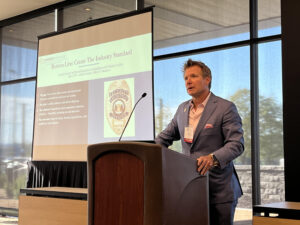
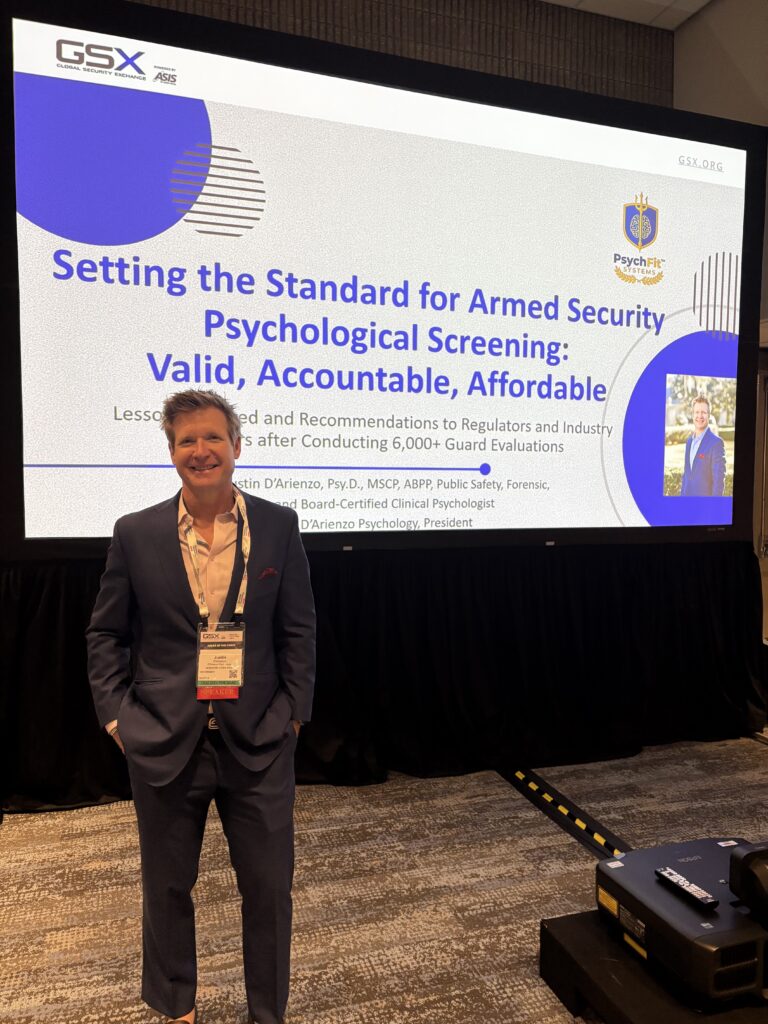
ASSIST 2026: Beyond Compliance
At the Associated Security Services and Investigators of the State of Texas (ASSIST) annual conference in San Antonio (October 6–8, 2026), Dr. D’Arienzo was featured for his October 7 session, “Beyond Compliance: Using the MMPI to Improve Armed Security Officer Selection.” The presentation addressed how security firms can move beyond minimum testing requirements to incorporate job-relevant psychological suitability, consistency, and responsible selection practices.
He also presented to ASSIST in 2025 on public safety psychological testing. Explore the approach discussed at GSX and ASSIST ›
Video Guidance for Texas MMPI Applicants
Prefer a video explanation? These resources explain the screening process and common applicant questions. They are educational and do not replace individualized guidance.
Texas MMPI Testing and PSP-13: Frequently Asked Questions
Is MMPI testing required for Texas Level III and Level IV licenses?
Yes. MMPI documentation is required for covered Level III commissioned officer applications and Level IV personal protection officer applications, subject to the rules and treatment of valid prior testing.
Do I need a new MMPI every time I renew?
Generally no. Texas DPS states that an MMPI remains valid indefinitely unless withdrawn, denied, or invalidated. Applicants should confirm their specific TOPS documentation requirements.
Can I do the Texas MMPI-3 evaluation online?
Online administration and video interviews may be available when legally and professionally appropriate, including verification of identity and secure test administration. DPS allows testing by a psychologist or psychiatrist licensed in the state where the assessment is administered.
How long does the MMPI-3 take?
Pearson estimates approximately 30–50 minutes for the MMPI-3 itself. Allow more time for intake, the professional interview, and any needed follow-up.
Will I automatically receive a signed PSP-13?
No. The licensed psychologist or psychiatrist must interpret the evaluation and make the required determination. If the data are invalid or concerns require further review, a favorable PSP-13 cannot be guaranteed.
Can a security company arrange testing for multiple guards?
Yes. Contact the practice to discuss candidate volume, administrative coordination, record handling, payment arrangements, and the appropriate scope of psychological screening.
How much does the evaluation cost, and is insurance accepted?
Request current individual pricing or an employer quote before scheduling. Occupational screening generally is not reimbursed as medically necessary psychotherapy, and payment options should be confirmed with the office.
Get Started With Texas MMPI-3 Testing
Whether you are applying for a Level III commission, pursuing a Level IV personal protection license, or coordinating evaluations for an entire security workforce, D’Arienzo Psychology can discuss the next steps.
Call: 904-379-8094
Email: security@drdarienzo.com
Applicants: See Texas testing details | Employers: Discuss a screening program