- HOME
- PSYCH SERVICES
- BUSINESS & PERFORMANCE PSYCHOLOGY
- CLINICAL, COUPLES, & FAMILIES
- Psychologist, Therapist, or Counselor? Which is Right for You
- ADHD Treatment & Evaluation Services
- Anger Management
- Anxiety Treatment & Evaluation Services
- Borderline Personality Treatment Services
- Cognitive Behavioral Therapy (CBT) Self-Help
- Couples Counseling and Marital Therapy
- Consent for Psychological Services for Minors Post-Divorce
- Depression Treatment Services
- Infidelity Recovery
- Jacksonville Counseling and Psychology
- Military Psychology & Tricare
- Narcissistic Personality Treatment Services
- Online Counseling
- Psychoeducational Testing
- Psychological Testing and Assessment
- Psychotherapy & Counseling
- FORENSIC PSYCHOLOGY & EXPERT TESTIMONY
- LIFE COACHING & EXECUTIVE COACHING
- PSYCHOLOGICAL PUBLIC DISABILITY QUESTIONNAIRES (DBQ)
- ONLINE COURSES
- Our Partnership Begins When You Purchase an Online Course
- Get to Know Dr. D’Arienzo, Relationship Expert
- Florida Premarital Preparation Online Course
- Georgia Premarital Education Online Course
- TwogetherinTexas Premarital Online Course
- Tennessee Premarital Preparation Online Course
- Minnesota Premarital Education Course Online
- Oklahoma Premarital Counseling Online Course
- South Carolina Premarital Preparation Course
- West Virginia Premarital Education Course
- Online Marriage and Relationship Tune Up Course
- Florida DCF Certified Parent Education and Family Stabilization Online Course
- Georgia Qualified Parent Education and Family Stabilization Online Course
- Texas Qualified Parent Education and Family Stabilization Online Course
- High Conflict Co-Parenting Online Certificate Course (8 Hours)
- Online Anger Management Four Hour Course (Level 1)
- Online Anger Management Eight Hour Course (Level 2)
- Sexual Harassment Online Training
- MMPI/GUARD/LEO
- CPI Police and Public Safety Assessment
- G License Psychological Testing
- Online Psychological Testing for Armed Security Guards and Personal Protection Officers
- MMPI Texas Level III CSO and IV PPO Psychological (ONLINE)
- Requirement for Texas Security License Applicants: MMPI Evaluation
- Level 3 Security Guard New Mexico Online MMPI Psychological Evaluation
- PsychFit Systems Capability Statement for LEO and Armed Guard Evaluations
- TEAM
- SOCIAL MEDIA/BOOKS


Armed Security Officer Psychological Screening: 10 Questions Employers Should Ask
Posted by: Dr. Justin D'Arienzo, Psy.D., ABPP
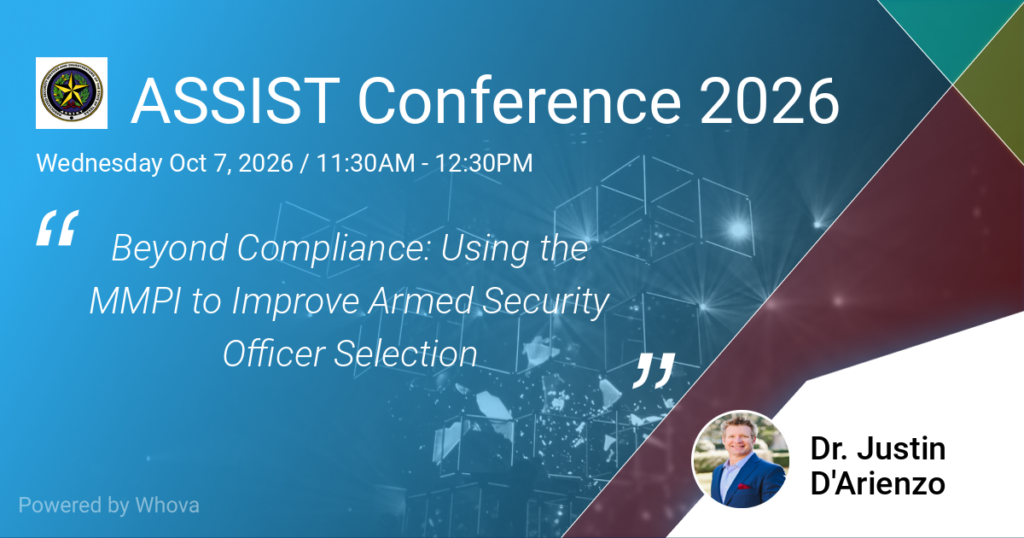
Psychological evaluations for armed security officers should do more than satisfy a state licensing requirement or client mandate. Effective psychological screening should help employers determine whether an individual has the emotional stability, judgment, impulse control, stress tolerance, interpersonal skills, and behavioral characteristics necessary to safely perform armed security work.Dr. Justin D’Arienzo provides psychological evaluations and MMPI testing for armed security officers and public-safety personnel throughout the United States. On October 7, 2026, he will present Beyond Compliance: Using the MMPI to Improve Armed Security Officer Selection at the Associated Security Services and Investigators of the State of Texas (ASSIST) 2026 Conference.
Psychological Stability vs. Psychological Suitability for Armed Security Officers
An armed security officer may be required to manage conflict, interact with distressed members of the public, make rapid decisions under pressure, follow detailed procedures, communicate with law enforcement, exercise restraint, respond to emergencies, and safely carry a firearm.
Those responsibilities require more than the absence of significant psychological problems. An effective evaluation should consider two related but different questions:
- Psychological stability: Is there evidence of psychological or emotional problems that could interfere with the safe performance of the position?
- Psychological suitability: Does the candidate demonstrate the job-related personality characteristics, judgment, emotional control, interpersonal skills, and behavioral tendencies necessary for this particular armed position?
A candidate can appear psychologically stable in a traditional clinical sense while still demonstrating behavioral patterns that raise legitimate questions about suitability for a specific safety-sensitive position.
Texas MMPI Requirements for Commissioned Security Officers
Texas provides a good example of why employers should distinguish minimum compliance from a broader employee-selection process. Effective January 1, 2024, Texas requires original and renewing applicants for a commissioned security officer license to complete the Minnesota Multiphasic Personality Inventory (MMPI).
The Texas Department of Public Safety explains the current MMPI requirement for commissioned security officers. Employers seeking testing can also learn more about our Texas MMPI testing and psychological evaluations for Level III and Level IV security personnel.
Completing a required psychological test, however, does not necessarily answer every question an employer should ask about whether someone is well suited for armed security work. Licensing compliance and comprehensive occupational psychological evaluation are related, but they are not identical concepts.
10 Psychological Suitability Factors for Armed Security Officers
The California Commission on Peace Officer Standards and Training (POST) developed 10 psychological screening dimensions for evaluating job-related characteristics relevant to peace-officer performance. Although private security positions are not identical to sworn law-enforcement positions, these dimensions provide a useful framework for thinking about psychological suitability in armed security roles.
Employers and psychologists should always consider the actual essential functions and demands of the specific position rather than assuming every armed-security assignment requires exactly the same characteristics.
1. Social Competence: Can This Officer Interact Effectively With Other People?
Security officers routinely interact with employees, customers, patients, visitors, residents, supervisors, suspects, law-enforcement officers, and members of the public. Technical competence alone may not be enough if an officer consistently creates unnecessary interpersonal conflict.
An effective armed security officer should be capable of communicating appropriately, reading social situations, maintaining professional boundaries, and interacting effectively with a wide range of personalities.
In many security assignments, communication and de-escalation are among the officer’s most important tools.
2. Teamwork: Can This Person Work Effectively With Others?
Armed security rarely occurs in complete isolation. Officers may need to coordinate with fellow security personnel, supervisors, police officers, firefighters, emergency medical personnel, hospital employees, school administrators, corporate leadership, or government personnel.
A candidate who has significant difficulty accepting direction, cooperating with coworkers, or functioning within an organizational structure may create operational problems even when psychological testing reveals no significant clinical concerns.
Security is an organizational function, not simply an individual one.
3. Adaptability and Flexibility: Can the Officer Respond When Circumstances Change?
Security assignments often involve long periods of routine interrupted by unexpected events. An officer may move quickly from monitoring an entrance to responding to a medical emergency, aggressive individual, fire alarm, security breach, active threat, or rapidly changing crowd situation.
Employers should consider whether a candidate can adjust to changing circumstances without becoming excessively overwhelmed, rigid, confused, or ineffective.
4. Conscientiousness and Dependability: Can I Rely on This Person?
An armed security officer must arrive for assigned shifts, follow post orders, complete reports, protect property, maintain equipment, follow firearm procedures, document incidents accurately, and carry out responsibilities even when direct supervision is limited.
Some of the most important security work is also the least exciting. An officer who performs appropriately only when closely supervised may present concerns in assignments requiring significant independence and personal responsibility.
5. Impulse Control and Attention to Safety: Can This Person Remain Controlled?
For armed personnel, impulse control and attention to safety are particularly important. These characteristics affect how an officer responds to provocation, handles a firearm, manages confrontation, follows procedures, and makes decisions when emotions are running high.
An armed officer may be insulted, challenged, threatened, or physically confronted. The relevant question is not whether the officer ever experiences anger or frustration. The question is whether the individual can remain sufficiently controlled to respond professionally, safely, and proportionately.
When a firearm is involved, the potential consequences of poor impulse control become substantially greater.
6. Integrity and Ethics: Can This Person Be Trusted?
Integrity and ethical behavior are fundamental to security work. Security officers may have access to private property, confidential information, restricted areas, evidence, keys, access credentials, weapons, or vulnerable individuals.
They may also be expected to accurately document events that no supervisor personally witnessed. Employers therefore need to consider honesty, ethical behavior, rule adherence, accountability, and willingness to accept responsibility for one’s actions.
No psychological test should be expected to replace a broader evaluation of integrity, personal history, employment history, and relevant behavior.
7. Emotional Regulation and Stress Tolerance: Can This Officer Function Under Stress?
Security officers are routinely placed in circumstances most employees try to avoid. They may encounter violence, threats, psychiatric crises, intoxicated individuals, injuries, frightened employees, grieving families, emergencies, or angry members of the public.
Feeling stress is normal. Psychological screening should not search for people who never experience anxiety, anger, fear, sadness, or frustration. The occupational question is whether an individual can appropriately regulate those emotions and continue functioning effectively while performing the job.
8. Decision-Making and Judgment: Can This Person Make Sound Decisions Under Pressure?
Security officers may have only seconds to decide whether to intervene, disengage, request law-enforcement assistance, issue commands, evacuate an area, detain an individual, provide emergency assistance, or potentially use force.
The consequences of poor decisions can be significant. A candidate may demonstrate no major psychological disorder and still show patterns of behavior or judgment that raise legitimate questions about decision-making under pressure.
This is one reason psychological suitability is broader than simply determining whether someone is psychologically stable.
9. Assertiveness: Can This Person Exercise Authority Without Unnecessary Aggression?
Armed security requires an unusual balance. Officers sometimes need to take control of a situation, establish boundaries, deny access, issue directions, enforce rules, or intervene in conflict.
Someone who is excessively passive may struggle to perform those duties. Someone who is excessively confrontational may unnecessarily escalate situations. The relevant characteristic is appropriate, professional assertiveness.
Effective security officers should be able to communicate authority without relying on unnecessary hostility or dominance.
10. Risk-Taking: Does This Person Engage in Unnecessary or Unsafe Behavior?
The final POST dimension addresses substance abuse and other risk-taking behavior. Armed security personnel should demonstrate responsible behavior because their positions may involve firearms, vehicles, emergency response, access to sensitive facilities, confrontation, equipment, and independent decision-making.
Patterns of reckless behavior, substance misuse, chronic rule violations, or unnecessary risk-taking may therefore warrant careful consideration. The relevant issue is generally not whether someone has ever made a mistake. The issue is whether available information suggests a meaningful pattern of behavior that could create unacceptable occupational risk.
Employers and evaluators interested in the underlying public-safety framework can review the California POST Peace Officer Psychological Screening Manual.
Why MMPI Testing Is Important but Is Not the Entire Evaluation
The MMPI can provide valuable information about psychological functioning, personality characteristics, and response style. It can be an important component of psychological screening for armed personnel.
However, employers should avoid treating an acceptable MMPI profile as proof that a candidate possesses every characteristic necessary for armed-security work.
A comprehensive occupational or public-safety psychological evaluation may incorporate multiple sources of information, depending on the purpose of the evaluation and applicable professional, legal, contractual, and regulatory requirements. These may include:
- Objective psychological testing
- A psychological or occupational interview
- Personal and employment history
- Relevant background information
- Essential job functions and job descriptions
- Collateral information when appropriate
- Additional measures of normal personality or job-related suitability when indicated
Consider a candidate whose MMPI shows no significant clinical elevations but whose interview and work history reveal repeated workplace confrontations, difficulty managing anger when challenged, and a pattern of escalating interpersonal conflict.
That individual might appear psychologically stable in the traditional clinical sense. The remaining occupational question is different:
Is this individual psychologically suitable for this particular armed-security position?
Psychological Screening Should Start With the Job
Psychological screening should ultimately flow from the essential functions and actual demands of the position.
A hospital security officer may require exceptional emotional regulation and de-escalation skills. An executive-protection officer may require unusually strong judgment, discretion, situational awareness, and interpersonal competence. An officer assigned to critical infrastructure may require exceptional dependability, attention to safety, and adherence to procedure. A retail security officer may frequently encounter verbal confrontation and therefore require strong social competence and impulse control.
There is no reason to assume that every armed-security assignment presents exactly the same psychological demands.
This job-specific approach is one reason D’Arienzo Psychology’s armed security officer psychological evaluation services can be tailored to the needs of security firms, government contractors, corporations, schools, and other organizations employing armed personnel.
Beyond Compliance: Better Armed Security Officer Selection
For security companies, the goal of psychological screening should not simply be to ask:
“Did this person complete the required MMPI?”
A more useful employee-selection process asks:
- Can this person communicate effectively?
- Can this person work appropriately with others?
- Can this person adapt when circumstances change?
- Can this person be depended upon?
- Can this person control impulses and behave safely?
- Can this person be trusted?
- Can this person appropriately manage stress?
- Can this person make sound decisions?
- Can this person exercise appropriate authority?
- Can this person avoid unnecessary risk?
Those questions move psychological screening beyond completion of a licensing requirement and toward a broader consideration of whether the candidate’s characteristics are appropriate for the actual responsibilities of the position.
ASSIST 2026: Beyond Compliance
Dr. Justin D’Arienzo will present Beyond Compliance: Using the MMPI to Improve Armed Security Officer Selection at the 2026 conference of the Associated Security Services and Investigators of the State of Texas (ASSIST) on October 7, 2026.
The presentation will examine the distinction between psychological stability and psychological suitability, the use of objective psychological testing in armed-security selection, job-related psychological characteristics, and ways security organizations can develop more comprehensive and defensible psychological screening programs.
Video: Psychological Screening for Armed Security Personnel
About Dr. Justin D’Arienzo
Dr. Justin D’Arienzo is a psychologist specializing in forensic, occupational, public-safety, and armed-security psychological evaluations. He provides psychological testing and evaluation services for armed security personnel, personal protection officers, law-enforcement candidates, government contractors, and other safety-sensitive positions.
His work focuses on helping organizations move beyond minimum compliance by considering both psychological stability and job-related psychological suitability when evaluating individuals who may carry firearms or work in other high-risk positions.
Psychological Evaluations for Armed Security Officers
D’Arienzo Psychology provides psychological testing and evaluations for armed security guards and personal protection officers, including MMPI testing and occupationally focused psychological evaluations for organizations throughout the United States.
Texas security companies can also learn more about our Texas Level III and Level IV MMPI psychological evaluation services.
If your security firm, government contractor, corporation, school, or organization needs psychological evaluations for armed personnel, contact D’Arienzo Psychology to discuss the type of assessment that best fits the position and applicable requirements.
Phone: 904-379-8094
Email: security@drdarienzo.com
This article provides general educational information regarding psychological screening and occupational suitability. Specific evaluation requirements may vary depending on the jurisdiction, position, employer, contractual requirements, and applicable laws and professional standards.
San Jose Office


 D'Arienzo Psychological Group: Forensic Psychology, Couples Counseling, Coaching
 © 2026 Dr D'Arienzo. All Rights Reserved