Armed security psychological evaluations should do more than determine whether someone completed a required psychological test. The more important question is whether the available information supports placing that individual in a position involving a firearm, independent judgment, public interaction, conflict management, and potentially life-or-death decision-making.
At GSX 2026 in Atlanta, Georgia, I presented on setting a standard for armed guard psychological evaluations, including the distinction between psychological stability and psychological suitability, the role of the MMPI, employment-law considerations, and the lack of consistency in armed-security psychological screening requirements across jurisdictions.
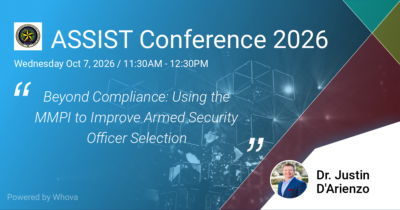
My next presentation will be at the Associated Security Services and Investigators of the State of Texas (ASSIST) 2026 Conference in San Antonio, where I will present Beyond Compliance: Using the MMPI to Improve Armed Security Officer Selection.
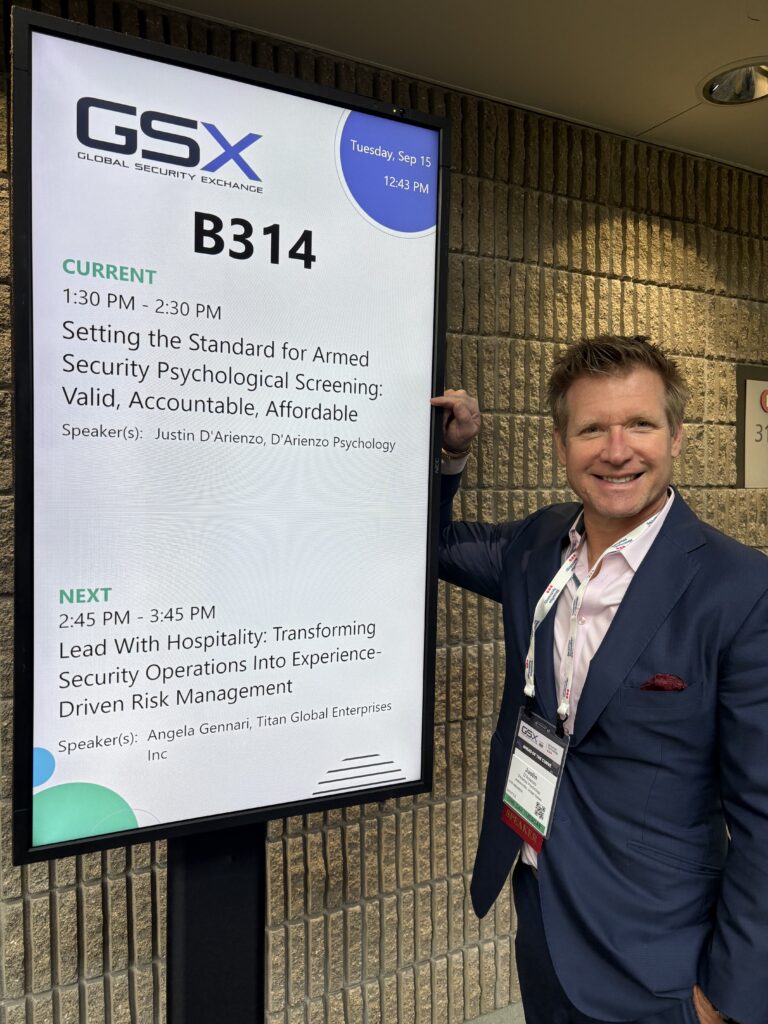
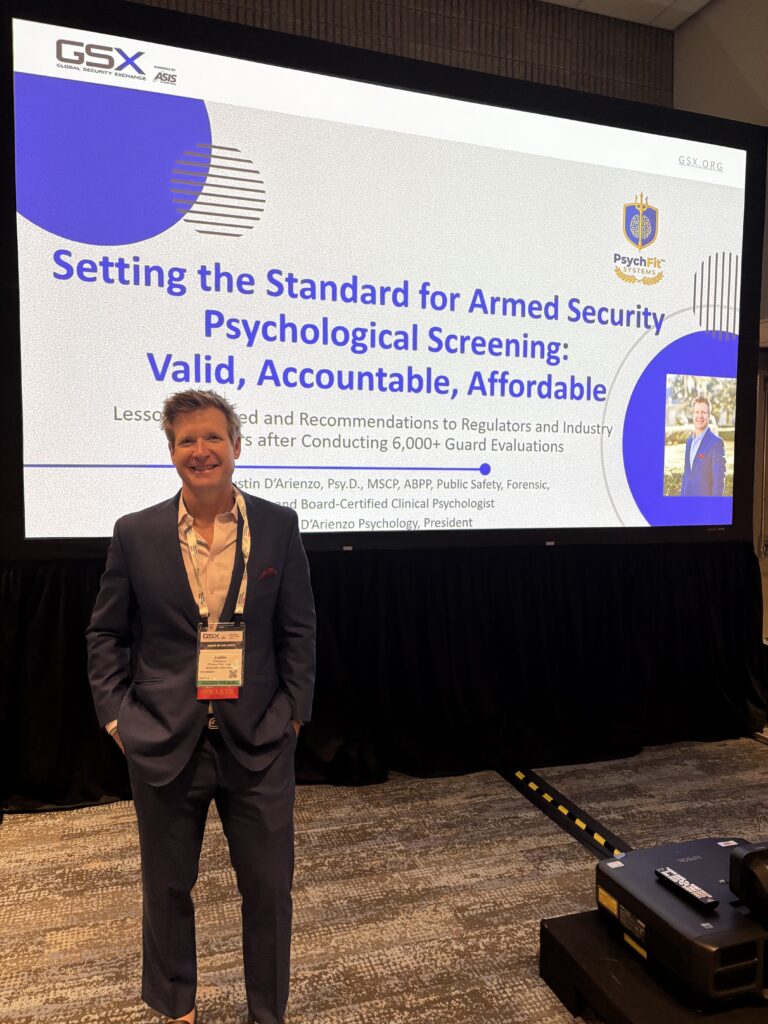
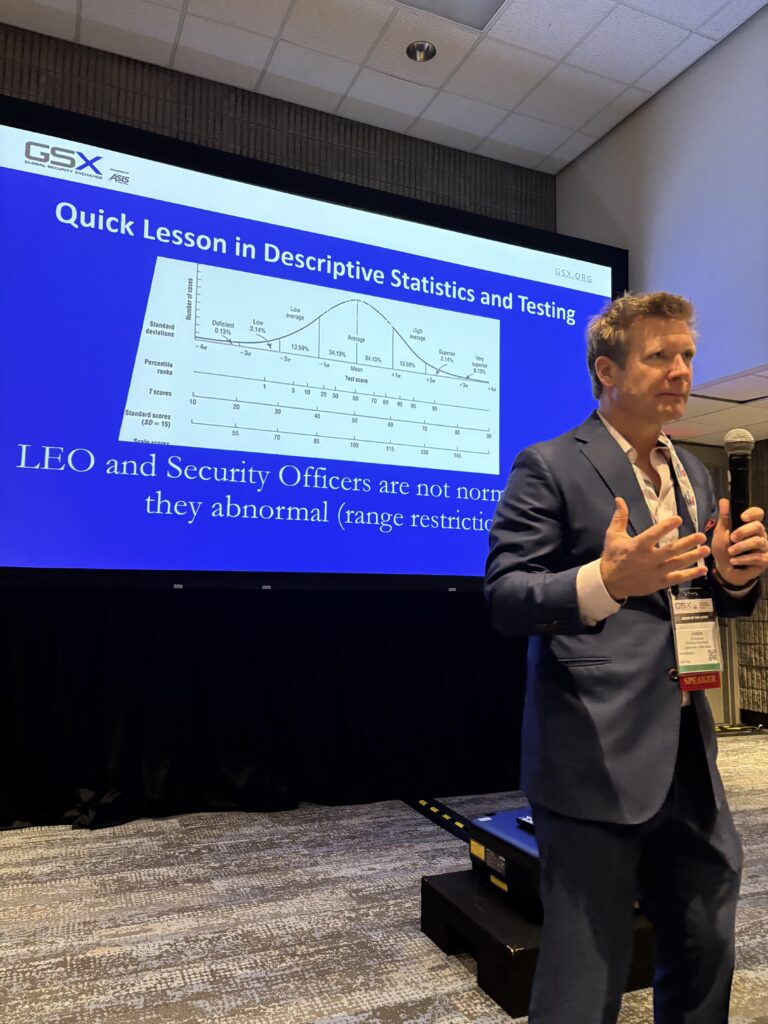
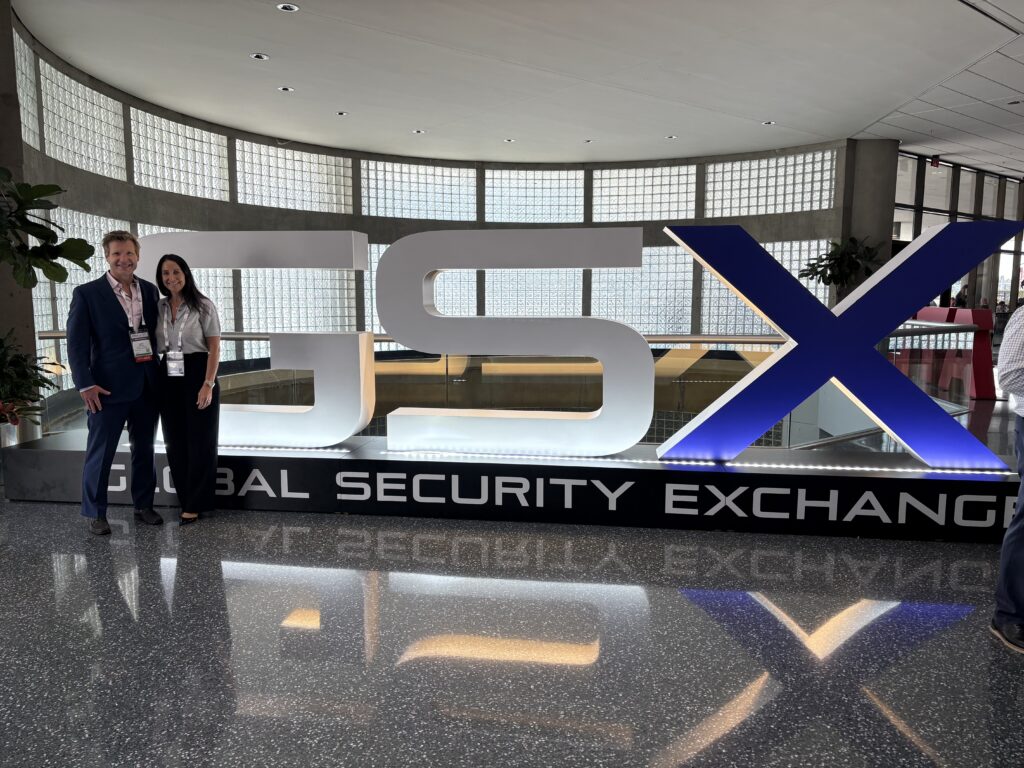
Dr. Justin D’Arienzo presenting on armed-security psychological evaluations at GSX 2026 in Atlanta, Georgia.

From GSX 2026 to ASSIST 2026: Moving Armed Security Evaluations Beyond Compliance
Hiring an armed security officer is different from hiring for most other positions. Armed officers may be expected to respond to emergencies, manage confrontation, make rapid decisions under pressure, interact with distressed members of the public, exercise restraint, follow detailed procedures, communicate with law enforcement, and safely carry a firearm.
For security companies, that creates a fundamental question:
Are we simply meeting a psychological testing requirement, or are we using psychological evaluation to help determine whether someone is suitable for the actual demands of armed work?
This distinction will be a central part of my October 7, 2026 ASSIST presentation, Beyond Compliance: Using the MMPI to Improve Armed Security Officer Selection.
Texas MMPI Requirements for Armed Security Officers
Texas illustrates why security companies need to understand the difference between regulatory compliance and a broader occupational psychological evaluation.
Beginning January 1, 2024, original and renewing applicants for a Texas commissioned security officer license are required to complete the Minnesota Multiphasic Personality Inventory (MMPI). The Texas Department of Public Safety identifies this requirement for commissioned security officers and provides additional guidance regarding MMPI administration.
Texas security firms and applicants can also learn more about our Texas MMPI psychological evaluations for Level III Commissioned Security Officers and Level IV Personal Protection Officers.
A licensing requirement establishes an important threshold. It does not necessarily answer every question an employer may have about whether a particular individual is psychologically suited to a particular armed-security assignment.
What Can the MMPI Tell Us About an Armed Security Candidate?
The MMPI-3 is the current version of the Minnesota Multiphasic Personality Inventory, while earlier versions such as the MMPI-2 and MMPI-2-RF remain in use in some settings.
The MMPI is one of the most extensively researched psychological assessment instruments and has a long history of use in clinical, forensic, occupational, and public-safety settings. Depending on the referral question and interpretive context, it can provide information relevant to areas such as:
- Emotional functioning and psychological distress
- Behavioral concerns
- Thought processes
- Substance-related concerns
- Interpersonal functioning
- Aggressiveness and behavioral control
- Response style and test-taking approach
The MMPI also contains validity measures designed to help psychologists evaluate how an examinee approached the assessment. This can be especially important in high-stakes occupational evaluations, where applicants may believe they need to appear psychologically perfect in order to obtain a favorable result.
What Should Applicants Know Before Taking the MMPI?
Security companies can reduce unnecessary anxiety by providing appropriate general instructions without coaching applicants on how to answer psychological test items.
- It is normal to feel anxious. Psychological evaluations can feel high stakes when employment or an armed position depends on the outcome.
- Get adequate sleep. Fatigue can make a lengthy psychological assessment more difficult and can interfere with concentration.
- Read each item carefully. Applicants should avoid unnecessarily rushing through the assessment.
- Respond honestly and consistently. Normal human experiences such as stress, frustration, sadness, anger, or worry do not automatically make someone unsuitable for armed work.
- Do not try to “beat” the test. Attempting to determine the supposedly perfect response to every item can produce an inaccurate picture of the applicant and may affect interpretability.
The goal of psychological assessment is not to identify a flawless human being. It is to obtain accurate information relevant to the referral question and the requirements of the position.
Psychological Testing Is Not the Same as a Psychological Evaluation
This is one of the most important distinctions for security companies to understand.
A psychological test is an assessment instrument. A psychological evaluation is a professional process that integrates relevant sources of information to address a specific referral question.
The American Psychological Association’s Professional Practice Guidelines for Occupationally Mandated Psychological Evaluations emphasize understanding the referring party’s authority, identifying the relevant criterion standard, understanding the psychological demands and working conditions of the position, and supporting job-relevant conclusions with established scientific and professional knowledge.
A comprehensive occupational evaluation may therefore incorporate several sources of information, depending on the purpose of the evaluation and applicable requirements:
- Objective psychological testing
- An individual psychological or occupational interview
- Relevant personal and employment history
- Job descriptions and essential job functions
- Background or risk information when appropriate
- Collateral information when relevant and authorized
- Additional personality or suitability measures when appropriate
Employers should therefore be cautious about assuming that obtaining an MMPI score by itself is equivalent to conducting a comprehensive occupational psychological evaluation.
Psychological Stability Is Not the Same as Psychological Suitability
This distinction is particularly important in public-safety and armed-security work.
Psychological stability generally focuses on whether clinically significant psychological problems could interfere with safe and effective performance.
Psychological suitability asks a broader occupational question:
Does this person demonstrate the psychological characteristics necessary to perform the essential functions of this particular job safely and effectively?
For example, an applicant might produce an MMPI profile without significant clinical elevations but describe during an interview a repeated pattern of workplace confrontation, extreme anger when challenged, poor acceptance of supervision, or unnecessary escalation of conflict.
Those characteristics may not necessarily indicate a psychiatric disorder. They may nevertheless be relevant to job-related qualities such as impulse control, emotional regulation, stress tolerance, interpersonal effectiveness, judgment, and decision-making.
10 Psychological Suitability Dimensions Relevant to Armed Security Work
The California Commission on Peace Officer Standards and Training (POST) developed a psychological screening framework identifying 10 job-related suitability dimensions for peace officers. Armed private-security work is not identical to sworn law enforcement, but the framework provides a useful model for considering the psychological demands of safety-sensitive armed positions.
- Social competence
- Teamwork
- Adaptability and flexibility
- Conscientiousness and dependability
- Impulse control and attention to safety
- Integrity and ethics
- Emotional regulation and stress tolerance
- Decision-making and judgment
- Assertiveness
- Avoidance of substance abuse and other risk-taking behavior
These characteristics translate naturally to many armed-security environments.
A hospital security officer may encounter psychiatric crises, intoxicated individuals, combative patients, frightened employees, or grieving family members. An executive-protection officer may require unusually strong discretion, judgment, situational awareness, and adaptability. An officer assigned to critical infrastructure may require exceptional dependability and adherence to procedures.
The appropriate psychological evaluation should therefore be informed by the essential functions and actual psychological demands of the position.
Start With the Job, Not the Psychological Test
One of the most useful lessons from occupational and public-safety psychology is that employers should not begin simply by asking:
“Which psychological test should we give?”
A better starting point is:
“What does this officer have to do, and what psychological characteristics are necessary to perform those duties safely and effectively?”
Depending on the assignment, relevant armed-security job demands may include:
- Responding to emergencies
- Making decisions under pressure
- Managing confrontation and de-escalation
- Exercising restraint
- Communicating effectively with the public
- Following detailed policies and post orders
- Maintaining vigilance during routine assignments
- Working with supervisors, coworkers, police, fire, and emergency personnel
- Handling sensitive or confidential information
- Carrying and potentially deploying a firearm safely
Once an employer understands the actual job demands, psychological screening becomes substantially more meaningful.
ADA Considerations in Armed Security Psychological Evaluations
Employers should also consider the timing and purpose of psychological evaluations under the Americans with Disabilities Act and other applicable employment laws.
Under EEOC guidance, employers generally may not require medical examinations before making a conditional job offer. After a conditional offer, medical examinations may be required if the employer applies the requirement consistently to all entering employees in the same job category.
Different standards generally apply once an individual is already employed. Medical examinations or disability-related inquiries involving current employees generally must satisfy applicable job-related and business-necessity requirements.
When employment decisions involve information suggesting a disability, employers should also consider whether the individual can perform the essential functions of the position, with or without reasonable accommodation, and applicable direct-threat standards.
For that reason, security firms should coordinate occupational psychological screening programs with qualified employment counsel and ensure that their procedures are consistent, job-related, appropriately timed, and carefully documented.
A Practical Psychological Evaluation Model for Security Companies
A security firm does not necessarily need to reproduce every component of a large law-enforcement selection system. A practical and defensible program can still incorporate core occupational-evaluation principles.
Depending on the jurisdiction, position, and referral purpose, a comprehensive process may consider:
- An appropriate validated psychological measure, including the MMPI when required or appropriate.
- An individual psychological interview addressing relevant occupational and behavioral history.
- Relevant employment and background information when available and appropriate.
- The essential functions and job description for the actual armed position.
- Job-relevant suitability characteristics such as judgment, impulse control, stress tolerance, dependability, integrity, and interpersonal functioning.
- Clear procedures for reporting results, retesting, appeals, and follow-up.
- Consistent implementation across similarly situated applicants or employees, while recognizing that legal requirements may differ between pre-offer, post-offer, and incumbent-employee evaluations.
Three Principles for a Strong Armed Security Psychological Screening Program
I encourage security companies to think about their psychological screening systems through three practical principles:
1. Validity
Are we evaluating psychological characteristics that actually matter for armed-security work using professionally appropriate methods?
2. Accountability
Is the evaluation process consistent, documented, professionally supervised, and resistant to problems such as unrestricted retesting or attempts to obtain a more favorable result from repeated evaluators?
3. Affordability and Scalability
Can the organization realistically implement the process across the size of its workforce while maintaining professional quality?
A screening system that is scientifically sophisticated but financially or operationally impossible to implement will have limited practical value. At the same time, a process that is inexpensive because it consists only of an isolated test score may provide insufficient information for a meaningful occupational decision.
The goal is to create a process that is valid, accountable, scalable, and appropriately matched to the risk and responsibilities of the position.
The Bottom Line: Go Beyond MMPI Compliance
For Texas security companies, the MMPI may begin as a licensing requirement. It should not necessarily be the end of the psychological evaluation process.
Security organizations should move beyond simply asking:
“Did the applicant pass the MMPI?”
A more meaningful occupational question is:
“Does the available information support placing this individual in an armed position with these particular responsibilities?”
That is the difference between psychological testing used primarily as a compliance exercise and psychological evaluation used as part of a thoughtful employee-selection and risk-management process.
The goal is not simply to get someone through a psychological test. The goal is to identify individuals whose psychological characteristics are appropriate for the responsibilities entrusted to them.
About Dr. Justin D’Arienzo
Dr. Justin D’Arienzo, Psy.D., MSCP, ABPP is a board-certified psychologist and former U.S. Navy psychologist whose work includes forensic, occupational, public-safety, law-enforcement, and armed-security psychological evaluations.
Dr. D’Arienzo has conducted thousands of psychological evaluations involving armed and safety-sensitive personnel and works with security companies, government contractors, corporations, schools, and public-safety organizations throughout the United States.
His work focuses on developing psychological evaluation programs that consider both psychological stability and occupational suitability while remaining efficient and scalable for organizations evaluating large numbers of personnel.
Armed Security Officer Psychological Evaluation Services
D’Arienzo Psychology and PsychFit Systems provide psychological evaluations and MMPI testing for armed security officers and personal protection personnel throughout the United States.
Organizations seeking a scalable program for law-enforcement, armed-security, or public-safety personnel can also review our PsychFit Systems capability statement for law-enforcement and armed-security psychological evaluations.
Texas companies can learn more about our Texas MMPI psychological evaluations for Level III and Level IV security personnel.
For additional information about developing or improving an armed-security psychological evaluation program, contact D’Arienzo Psychology:
Phone: 904-379-8094
Email: security@drdarienzo.com
This article provides general educational information regarding occupational psychological evaluations and should not be interpreted as legal advice. Specific requirements vary according to jurisdiction, licensing rules, employment status, contractual requirements, and the circumstances of the individual evaluation.