

- HOME
- PSYCH SERVICES
- BUSINESS & PERFORMANCE PSYCHOLOGY
- CLINICAL, COUPLES, & FAMILIES
- Psychologist, Therapist, or Counselor? Which is Right for You
- ADHD Treatment & Evaluation Services
- Anger Management
- Anxiety Treatment & Evaluation Services
- Borderline Personality Treatment Services
- Cognitive Behavioral Therapy (CBT) Self-Help
- Couples Counseling and Marital Therapy
- Consent for Psychological Services for Minors Post-Divorce
- Depression Treatment Services
- Infidelity Recovery
- Jacksonville Counseling and Psychology
- Military Psychology & Tricare
- Narcissistic Personality Treatment Services
- Online Counseling
- Psychoeducational Testing
- Psychological Testing and Assessment
- Psychotherapy & Counseling
- FORENSIC PSYCHOLOGY & EXPERT TESTIMONY
- LIFE COACHING & EXECUTIVE COACHING
- PSYCHOLOGICAL PUBLIC DISABILITY QUESTIONNAIRES (DBQ)
- ONLINE COURSES
- Our Partnership Begins When You Purchase an Online Course
- Get to Know Dr. D’Arienzo, Relationship Expert
- Florida Premarital Preparation Online Course
- Georgia Premarital Education Online Course
- TwogetherinTexas Premarital Online Course
- Tennessee Premarital Preparation Online Course
- Minnesota Premarital Education Course Online
- Oklahoma Premarital Counseling Online Course
- South Carolina Premarital Preparation Course
- West Virginia Premarital Education Course
- Online Marriage and Relationship Tune Up Course
- Florida DCF Certified Parent Education and Family Stabilization Online Course
- Georgia Qualified Parent Education and Family Stabilization Online Course
- Texas Qualified Parent Education and Family Stabilization Online Course
- High Conflict Co-Parenting Online Certificate Course (8 Hours)
- Online Anger Management Four Hour Course (Level 1)
- Online Anger Management Eight Hour Course (Level 2)
- Sexual Harassment Online Training
- MMPI/GUARD/LEO
- CPI Police and Public Safety Assessment
- G License Psychological Testing
- Online Psychological Testing for Armed Security Guards and Personal Protection Officers
- MMPI Texas Level III CSO and IV PPO Psychological (ONLINE)
- Requirement for Texas Security License Applicants: MMPI Evaluation
- Level 3 Security Guard New Mexico Online MMPI Psychological Evaluation
- PsychFit Systems Capability Statement for LEO and Armed Guard Evaluations
- TEAM
- SOCIAL MEDIA/BOOKS
Prescription Privileges for Specially Trained Psychologists
Posted by: Dr. Justin D'Arienzo, Psy.D., ABPP
What do you think about prescription privileges for specially trained psychologists?
Advancing the Future of Mental Health Care: A Milestone in Clinical Psychopharmacology
Psychologists are scientist-practitioners relying on real evidence and science when treating and evaluating patients. Adding to this training model, I want to share something I’m genuinely excited about that is both a personal and professional milestone that reflects my commitment to the evolving profession of psychology and expands what I hope to one day be able to offer patients in Florida.
In May 2026, I graduated from Fairleigh Dickinson University’s Postdoctoral Master’s Program in Clinical Psychopharmacology, an American Psychological Association’s (APA) designated program that prepares licensed psychologists for prescriptive authority in states where it is permitted. More recently (July 2026), I passed the Psychopharmacology Examination for Psychologists (PEP). The PEP is the national exam required for psychologists to pass who want to prescribe. It is an arduous test covering topics from clinical medicine, neuroscience, laboratory interpretation, general pharmacology to psychopharmacology. Passing it marks another real step forward in building advanced competency in this area. I worked my tail off to complete the program and pass the PEP while running our business, remaining active in the community and with my family, and seeing patients over the last two and a half years. My next step with psychopharmacology is to gain authority to prescribe in Louisiana and New Mexico. I will keep you updated.
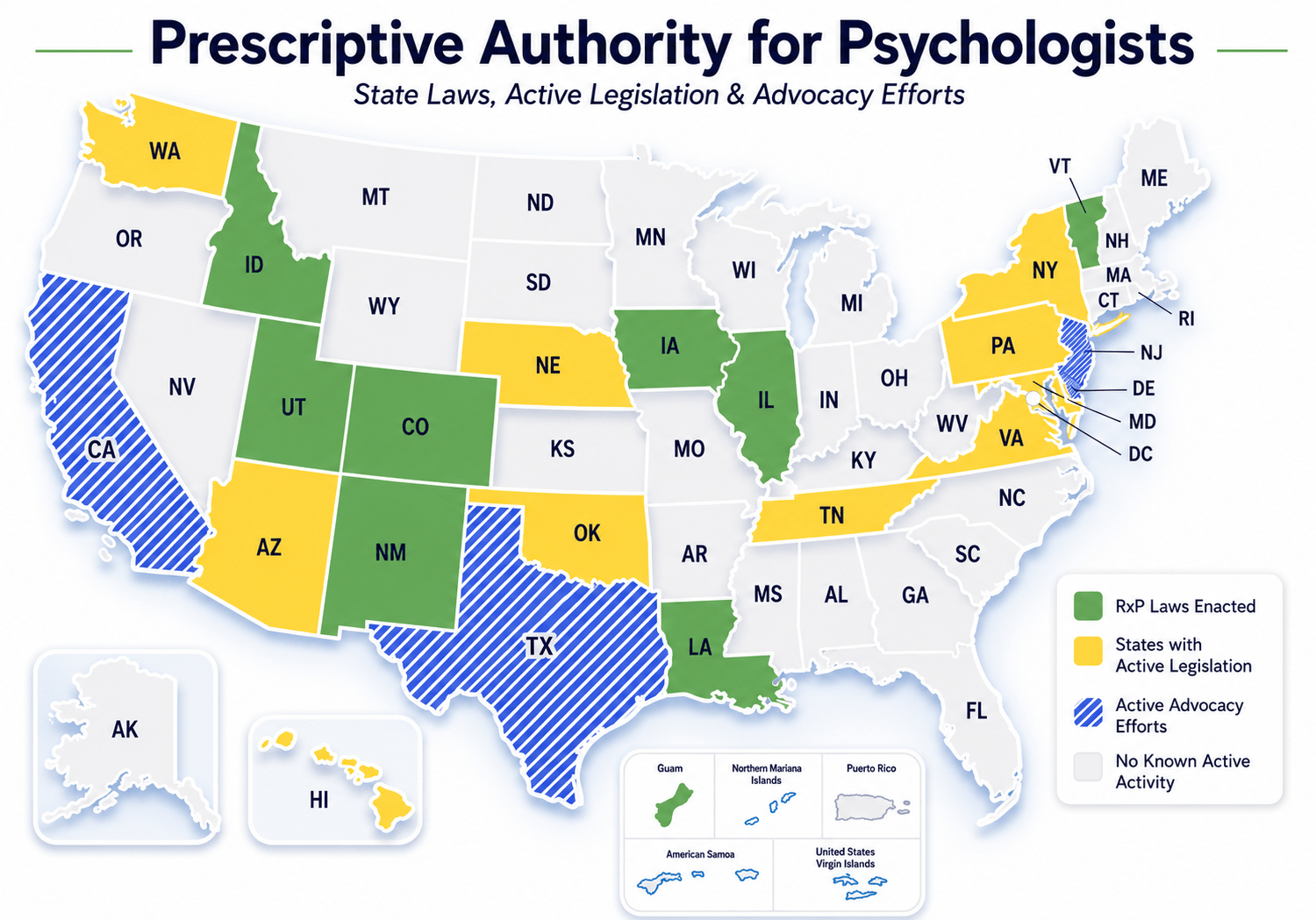
A Growing National Movement: Psychology as a field keeps evolving, and a big part of that is states looking for better ways to close the gap in mental health care access. In 2026, Vermont and Hawaii became the eighth and ninth states to let specially trained psychologists prescribe certain psychiatric medications under clearly defined rules, joining Colorado, Idaho, Illinois, Iowa, Louisiana, New Mexico, and Utah.
In many communities especially rural or underserved ones patients wait months just to get in with someone for medication management. Letting psychologists with advanced training step into that role is one way to help close that gap.
Just as I spoke of my own journey, getting here is not quick. Psychologists pursuing this path complete extensive postdoctoral coursework in neuroscience, pharmacology, physiology, pathophysiology, lab medicine, and physical assessment, on top of the clinical decision making training built into the post-doctorate masters degree itself. Then comes supervised clinical experience and the national PEP exam before a psychologist is even eligible to prescribe in a state that allows it.
Looking Ahead: To be upfront, passing the PEP does not let me prescribe in Florida right now. But it is an important step toward where I am headed long term. My next focus is completing the additional clinical requirements needed to pursue prescriptive authority in Louisiana, where trained psychologists can prescribe under state law once all the requirements are met. I am also hopeful Florida moves in this direction eventually. If that happens, I would welcome the chance to be part of it and keep expanding the care I can offer here. It seems ironic that I will be providing care virtually to Louisianians who cannot get in to see a psychiatrist or nurse practitioner, but I cannot see Floridians, where my office is located, in the same dilemma.
Continuing Our Commitment to Excellence: Whether it is psychotherapy, forensic evaluations, psychological testing, public safety evaluations, or consultation, my approach has always been the same… strong scientific grounding paired with genuinely patient and client centered care. This additional training deepens my understanding of how biological, psychological, and social factors intersect, and it makes collaborating with physicians and other healthcare providers even more effective. As the field keeps growing, I am committed to staying current, thoughtful, and focused on expanding access to safe, effective mental health care for the people I serve.
San Jose Office


 D'Arienzo Psychological Group: Forensic Psychology, Couples Counseling, Coaching
 © 2026 Dr D'Arienzo. All Rights Reserved