- HOME
- PSYCH SERVICES
- BUSINESS & PERFORMANCE PSYCHOLOGY
- CLINICAL, COUPLES, & FAMILIES
- Psychologist, Therapist, or Counselor? Which is Right for You
- ADHD Treatment & Evaluation Services
- Anger Management
- Anxiety Treatment & Evaluation Services
- Borderline Personality Treatment Services
- Cognitive Behavioral Therapy (CBT) Self-Help
- Couples Counseling and Marital Therapy
- Consent for Psychological Services for Minors Post-Divorce
- Depression Treatment Services
- Infidelity Recovery
- Jacksonville Counseling and Psychology
- Military Psychology & Tricare
- Narcissistic Personality Treatment Services
- Online Counseling
- Psychoeducational Testing
- Psychological Testing and Assessment
- Psychotherapy & Counseling
- FORENSIC PSYCHOLOGY & EXPERT TESTIMONY
- LIFE COACHING & EXECUTIVE COACHING
- PSYCHOLOGICAL PUBLIC DISABILITY QUESTIONNAIRES (DBQ)
- ONLINE COURSES
- Our Partnership Begins When You Purchase an Online Course
- Get to Know Dr. D’Arienzo, Relationship Expert
- Florida Premarital Preparation Online Course
- Georgia Premarital Education Online Course
- TwogetherinTexas Premarital Online Course
- Tennessee Premarital Preparation Online Course
- Minnesota Premarital Education Course Online
- Oklahoma Premarital Counseling Online Course
- South Carolina Premarital Preparation Course
- West Virginia Premarital Education Course
- Online Marriage and Relationship Tune Up Course
- Florida DCF Certified Parent Education and Family Stabilization Online Course
- Georgia Qualified Parent Education and Family Stabilization Online Course
- Texas Qualified Parent Education and Family Stabilization Online Course
- High Conflict Co-Parenting Online Certificate Course (8 Hours)
- Online Anger Management Four Hour Course (Level 1)
- Online Anger Management Eight Hour Course (Level 2)
- Sexual Harassment Online Training
- MMPI/GUARD/LEO
- CPI Police and Public Safety Assessment
- G License Psychological Testing
- Online Psychological Testing for Armed Security Guards and Personal Protection Officers
- MMPI Texas Level III CSO and IV PPO Psychological (ONLINE)
- Requirement for Texas Security License Applicants: MMPI Evaluation
- Level 3 Security Guard New Mexico Online MMPI Psychological Evaluation
- PsychFit Systems Capability Statement for LEO and Armed Guard Evaluations
- TEAM
- SOCIAL MEDIA/BOOKS


Integrating Psychological Screening Into Your Security Firm: From MMPI Compliance to Better Hiring
Posted by: Dr. Justin D'Arienzo, Psy.D., ABPP
Beyond Compliance: Using the MMPI to Improve Armed Security Officer Selection
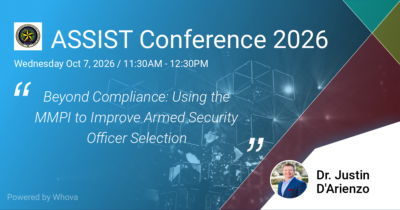
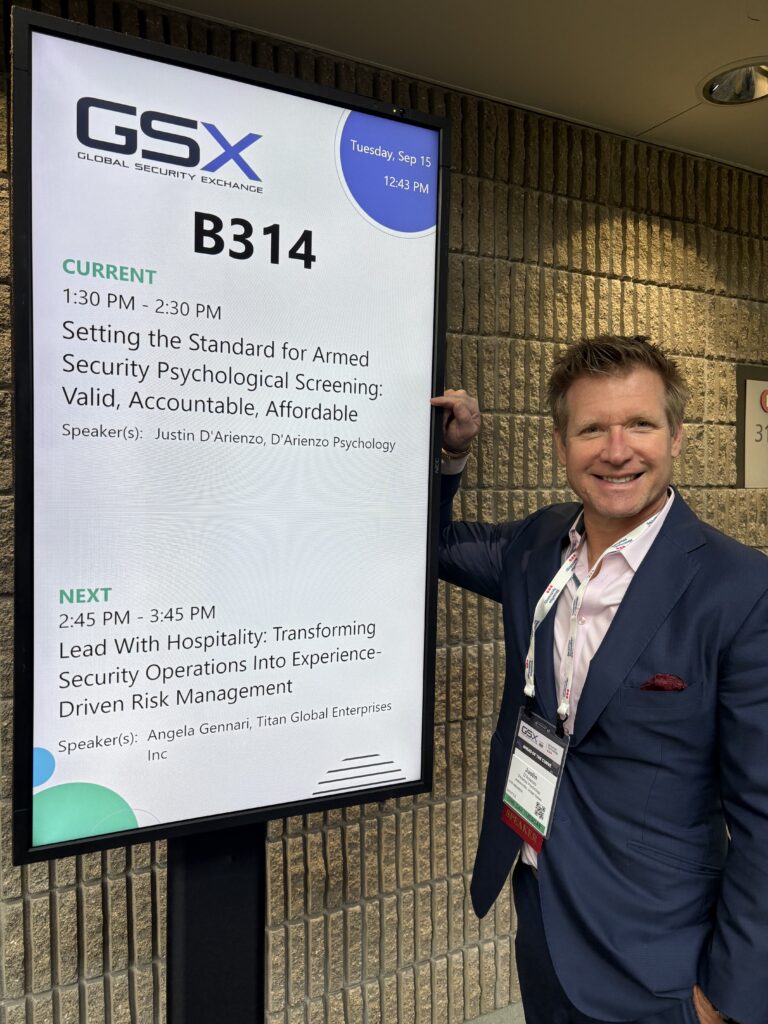
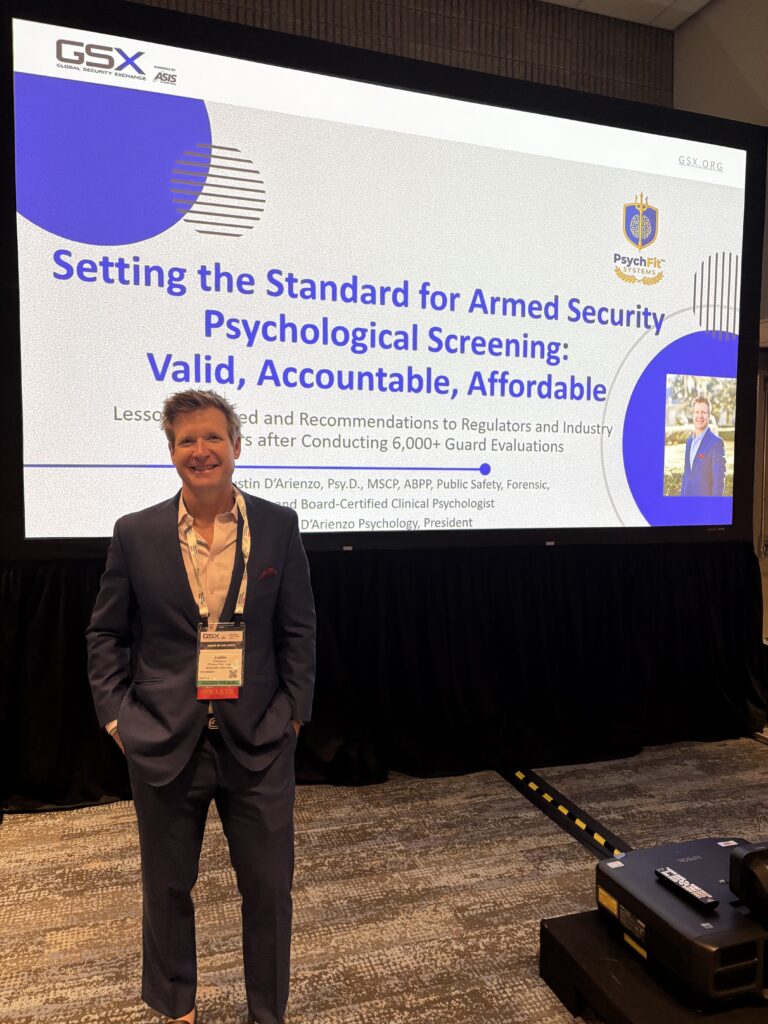
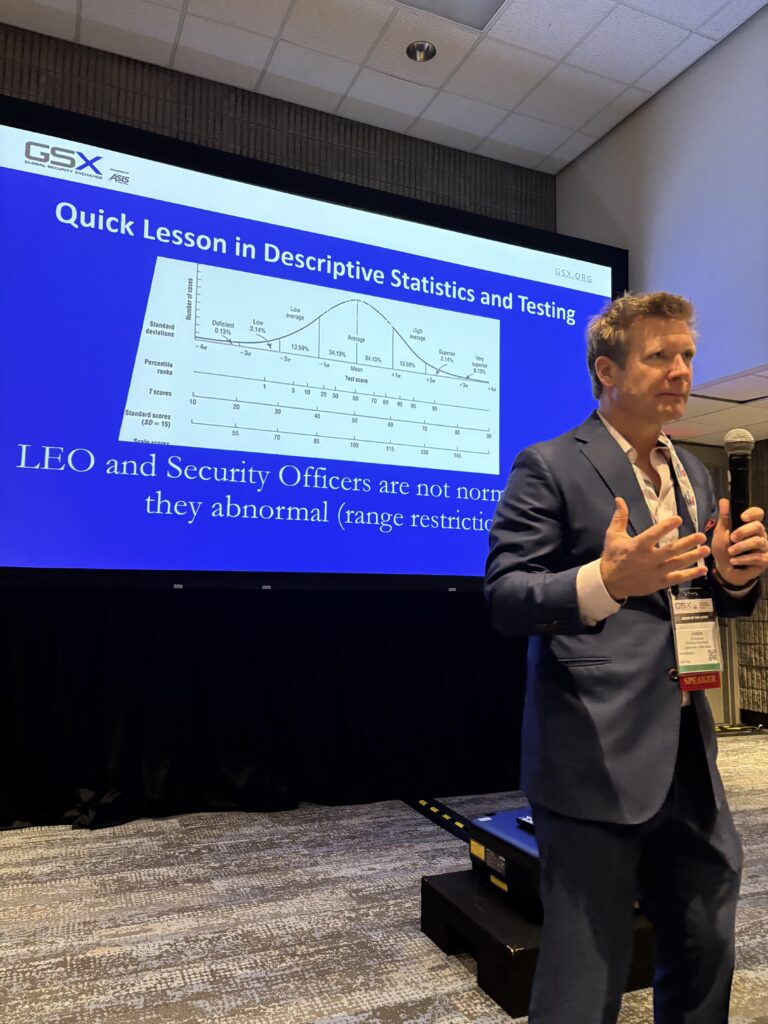
GSX in Atlanta, Georgia was a success this year. It was great to talk to customers and other prospective firms about how to better meet their needs. Dr. D’Arienzo presented about Setting a Standard for Armed Guard Evaluation, ADA compliance, and about the lack of regulatory consistency across states. The next stop will be San Antonio, Texas for the Associated Security Services and Investigators of the State of Texas where he will be presenting: Beyond Compliance: Using the MMPI to Improve Armed Security Officer Selection.
Hiring an armed security officer is not the same as hiring for an ordinary position. Armed officers may be expected to respond to emergencies, manage conflict, make rapid decisions under pressure, interact with distressed members of the public, exercise restraint, follow post orders, and safely carry a firearm. For security companies, that creates a central hiring question:
Are we simply meeting a psychological testing requirement, or are we using psychological screening to help select the right person for the job?
In Texas, applicants for a security officer commission are required to complete the Minnesota Multiphasic Personality Inventory, or MMPI. That requirement provides an important psychological screening safeguard. However, the MMPI should not be viewed as a stand-alone hiring system. Psychological testing is most useful when it is integrated into a broader occupational evaluation process that considers the individual, the position, and the demands of armed security work.
What the MMPI Can Tell Us
The MMPI is one of the most established psychological assessment instruments in use today and has a long history in public-safety evaluations. It can help psychologists evaluate patterns related to psychological functioning, emotional distress, behavioral concerns, unusual thinking, substance-related problems, and other areas that may be relevant to occupational functioning.
The MMPI also contains validity measures that help the psychologist understand how an individual approached the test. This is important because applicants sometimes believe they need to present themselves as psychologically perfect in order to pass.
That is usually the wrong approach.
Psychological testing is designed to look at patterns across many questions. Trying to outthink the test, hide every normal human weakness, or consistently choose what seems like the “best” answer can create its own problems.
Applicants should instead be encouraged to approach testing in a straightforward manner.
What Should You Tell an Employee Before the MMPI?
Security companies can reduce unnecessary anxiety by giving candidates appropriate guidance before testing without coaching them on how to answer.
A few simple instructions can help:
It is normal to feel anxious. Psychological testing can feel high stakes, particularly when an applicant knows that an armed position depends upon the outcome.
Get adequate sleep. Fatigue can affect concentration and make a lengthy psychological inventory more difficult.
Read each question carefully. Applicants should avoid rushing through the assessment.
Be honest, consistent, and not overly defensive. Everyone experiences frustration, stress, anger, sadness, worry, or interpersonal conflict at times. Acknowledging normal human experiences does not automatically disqualify someone from armed work.
Do not try to beat the test. There is no benefit to searching for the “perfect” response to every question.
The goal of the assessment is not to identify a flawless person. The goal is to obtain an accurate picture of the individual.
Psychological Testing Should Not Stand Alone
One of the most important principles security companies should understand is that a psychological test score is not the same thing as a psychological evaluation.
Professional public-safety and occupational evaluation models generally rely on multiple sources of information. These may include psychological testing, an individual interview, relevant background information, the job description, a history or risk questionnaire, and collateral information when appropriate.
An applicant can produce MMPI results that fall within acceptable limits and still raise concerns during an interview.
For example, imagine an experienced armed-security applicant whose psychological testing shows no major clinical elevations. During the interview, however, the applicant describes repeated confrontations with coworkers, becoming extremely angry when challenged, and a preference for taking control of conflict rather than attempting de-escalation.
That does not necessarily represent a psychiatric disorder.
It may, however, raise questions about impulse control, emotional regulation, stress tolerance, interpersonal effectiveness, and decision-making under pressure.
These are precisely the kinds of characteristics that matter when a person is carrying a firearm and representing a security company.
Stability Is Not the Same as Suitability
This is where security companies can learn from law-enforcement psychological screening.
The POST model used in public-safety settings distinguishes between psychological stability and psychological suitability.
Stability generally focuses on whether there is evidence of significant psychological dysfunction that may interfere with safe job performance.
Suitability asks a broader question:
Does this individual possess the psychological characteristics necessary to perform the essential functions of the job safely and effectively?
POST identifies several important suitability dimensions, including:
- Social competence
- Teamwork
- Adaptability and flexibility
- Conscientiousness and dependability
- Impulse control and attention to safety
- Integrity and ethics
- Emotional regulation and stress tolerance
- Decision-making and judgment
- Assertiveness
- Avoidance of substance abuse and other risky behavior
These characteristics translate naturally to private security.
An armed officer may have to tolerate verbal abuse without escalating the situation. Another may have to decide whether to intervene, disengage, summon law enforcement, evacuate an area, or use force. A hospital security officer may encounter psychiatric crises, intoxicated individuals, grieving families, or combative patients. An executive-protection officer may require discretion, situational awareness, and rapid decision-making.
The appropriate psychological screening process should therefore flow from the essential functions of the actual job.
Start With the Job, Not the Test
One of the most important lessons from public-safety psychology is that employers should not begin by asking:
“Which psychological test should we give?”
The better question is:
“What does this officer have to do, and what psychological characteristics are required to do it safely?”
Job analysis helps answer that question.
Relevant armed-security demands may include:
- Responding to emergencies
- Making decisions under stress
- Managing confrontation
- Exercising restraint
- Communicating with the public
- Following detailed procedures
- Maintaining vigilance during routine assignments
- Working effectively with supervisors, coworkers, police, and emergency personnel
- Handling sensitive information
- Carrying and potentially deploying a firearm safely
Once the employer understands the job demands, psychological screening becomes more meaningful.
A Practical Model for Security Companies
Security firms do not necessarily need to reproduce an expensive police-selection process for every guard.
A practical system can still incorporate the most important principles.
At a minimum, a defensible process should consider:
A validated psychological stability measure, such as the MMPI where required.
An individual psychological interview, rather than relying solely on a test score.
Relevant employment and background information.
The essential functions of the position.
Suitability characteristics, particularly for higher-risk armed assignments.
Clear procedures for reporting results, retesting, and follow-up.
The process should also be implemented consistently. For post-offer psychological evaluations, employers should ensure that screening practices are coordinated with applicable employment law and used consistently within comparable job categories.
Build the Program Around Three Principles
A useful way for security companies to evaluate their screening program is through three pillars:
Validity. Are we evaluating characteristics that actually matter for armed-security work, using appropriate methods?
Accountability. Is the process consistent, documented, and resistant to problems such as unrestricted retesting or “doctor-shopping”?
Affordability. Can the company realistically implement the process across a large workforce without making the evaluation so expensive that it becomes impractical?
A psychological screening program that is scientifically sophisticated but financially impossible will not be widely implemented. At the same time, an inexpensive process consisting only of a test score may provide too little information for a meaningful occupational decision.
The goal is balance.
The Bottom Line
For Texas security companies, the MMPI may begin as a licensing requirement. It should not end there.
The most effective psychological screening programs use testing as one part of a broader employee-selection process. They consider psychological stability, occupational suitability, job demands, interview findings, and other relevant information.
Security companies should not simply ask:
“Did the applicant pass the MMPI?”
They should ask:
“Does the available information support putting this individual in an armed position representing our organization?”
That is the difference between psychological testing as a compliance exercise and psychological screening as a meaningful risk-management and employee-selection tool.
The goal is not simply to get someone through the MMPI. The goal is to put the right person in the armed position.
If you would like more information about our armed guard evaluations or other occupationally mandated psychological evaluations, contact us at 904-379-8094 or at security@drdarienzo.com
San Jose Office


 D'Arienzo Psychological Group: Forensic Psychology, Couples Counseling, Coaching
 © 2026 Dr D'Arienzo. All Rights Reserved